It is well-documented that the Chinese Communist Party employs a so-called social credit system. Albeit fragmented, it is capable of evaluating individuals, businesses, and institutions based on their compliance with communist ideals.
Frankly, this is nothing new. More surprising is the growing number of Western politicians contemplating a synthesis of such systems with liberal democracies.
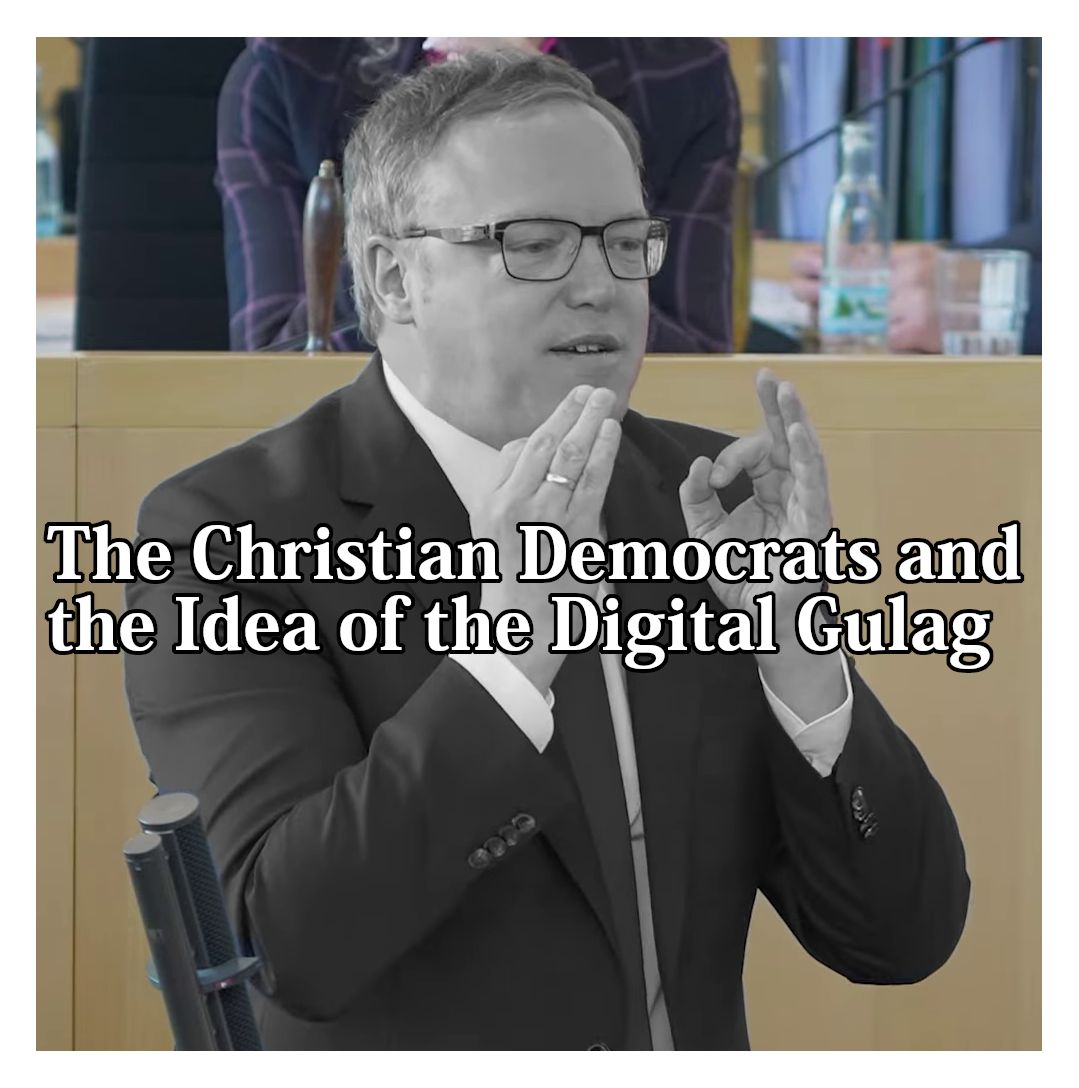
Just recently, the German politician Mario Voigt—a possible contender for the office of Minister-President of Thuringia—proposed multiple measures to combat hate crimes and fake news on social media during a speech in the Landtag. In addition to proposing a ban on bots, he called for a mandatory real-name policy for all social media users, akin to what Elon Musk had in mind for Twitter (now X), though he has not yet implemented it. Any such proposal would directly undermine individual anonymity. Fortunately, a handful of countries have already ruled similar measures unconstitutional.
This alone wouldn’t warrant an article. What is staggering is Voigt’s conception of revocable social media licenses. These could be annulled by the state if a user is found to be abusing their social media presence. While I equally reject both the real-name policy and the idea of revocable social media licenses, the former admittedly relies on more rigid and verifiable criteria. A name can be confirmed with certainty. The latter, however, leaves room for dangerous arbitrariness. Whatever constitutes a hate crime or fake news is subject to interpretation and consequently opens the door to oppression. It is debatable whether the judiciary should even be involved in validating information in the first place.
This system of depriving individuals of access to online spaces is what I call the Digital Gulag. James Lindsay coined the term in a 2022 podcast. The Gulag was a system of concentration, labor, and—more importantly—reeducation camps in the Soviet Union. The term is to be understood metaphorically, as a one-to-one reinstatement is unlikely. The act of being exiled into the Digital Gulag might be as effective as the mere threat of ending up there. The phrase “Punish one, teach a hundred” comes to mind.
Elections in Thuringia are set to take place in September 2024. Voigt’s Christian Democratic Union (CDU) currently has the best chance of taking office. However, the feasibility of implementing these plans is doubtful. There are numerous examples of other politicians entertaining similar ideas. My concern lies with the all-permeating mindset—transcending political parties—of micromanaging online spaces and, by extension, society as a whole. Future considerations might include the coupling of state-issued licenses with other aspects of life, such as monetary income in the form of a Universal Basic Income (UBI). Initial enthusiasm must be tempered; there is no such thing as free money. In a post-market society, compliance will become the currency.
Sources
- Mario Voigt’s speech, https://youtu.be/5ZdfDcEIh24?t=17m20s
- The Gulag system, https://en.wikipedia.org/wiki/Gulag
- 21st Century Re-Education, The Digital Gulag, https://newdiscourses.com/ 2022/08/21st-century-re-education-digital-gulag/